Is it worth it? What mental fatigue is really telling you
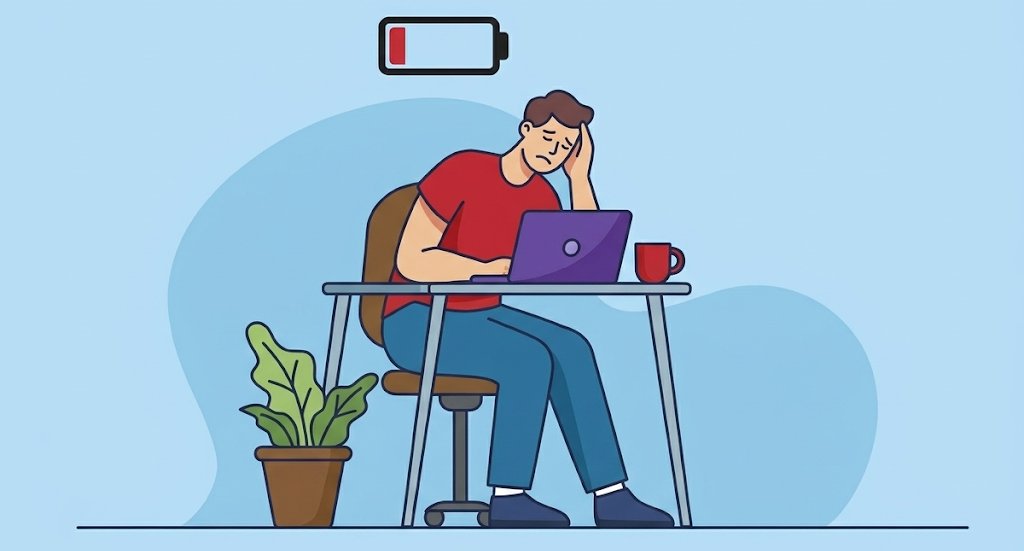
Why do some people work long hours without ever feeling drained, while others are exhausted by lunchtime? Is mental fatigue simply your brain running out of energy? Or is it a signal, and if so, what is it trying to tell you?
If you are reading this at the end of a working day, there's a fair chance you are tired. And you're not alone. In the Netherlands, about half of all working women and a third of working men complain of fatigue, a clear rise compared to fifteen years ago. In the United States, a large survey found that 38% of workers had been fatigued in the previous two weeks (Ricci et al., 2007). Two thirds of those tired workers reported losing productive time at work, against about a quarter of those who weren't tired. Add it all up, and fatigued workers cost American employers more than a hundred billion dollars a year in excess lost productivity. That's a lot of tired brains.
Over the past decades, our work has changed from mostly physical to mostly mental. We no longer lift and carry; we read, write, plan and decide, often for hours on end. So it's perhaps not surprising that mental fatigue has become one of the most common complaints of modern working life.
But here is something that is surprising. You would expect that the longer you work, the more tired you get. Simple arithmetic, right? Except that it doesn't seem to work that way. People can feel exhausted after a fairly short stretch of work, while working long hours does not always lead to fatigue. In fact, long hours appear to do little harm when people feel that the rewards of their work (pay, but also appreciation from colleagues and the manager) are high (Siegrist, 1996; Van der Hulst & Geurts, 2001). In other words: a heavy workload only seems to wear people out when the rewards are low.
How do we explain this? In a review that Mattie Tops and I have just published in Brain Research Reviews (Boksem & Tops, 2008), we propose an answer. Mental fatigue, we argue, is not about running out of energy at all. It's about a calculation that your brain makes, continuously and largely outside your awareness: is what I'm doing still worth the effort?
What is mental fatigue, anyway?
Mental fatigue is the feeling you get during or after a long period of demanding mental work. You'll know the symptoms: a sense of tiredness or even exhaustion, an aversion to carrying on with whatever you're doing, and a dwindling commitment to the task at hand.
It also shows up in how well we think. Fatigued people have trouble planning and get stuck in strategies that no longer work: when the rules of a task change, they keep doing what worked before (Van der Linden et al., 2003). In our own experiments, volunteers who worked on a demanding task for three hours without a break became easily distracted by things they were supposed to ignore (Boksem et al., 2005). They also prepared their responses less well, and after making a mistake, they were less likely to correct it or to adjust their behavior to avoid the next one (Lorist et al., 2005; Boksem et al., 2006).
So far, so familiar. The obvious explanation is that the brain has some kind of fuel tank, and that this tank slowly drains as we work. But if that were true, how could people work long, hard hours without getting tired, as long as their work feels rewarding?
What makes us tick?
Perhaps it helps to turn the question around. Instead of asking why we stop, let's ask why we start. What gets you out of bed in the morning and off to work, to school or to whatever else is on the agenda? Clearly, there must be something in it for you. There must be some reward.
Take the African cheetah. To stay alive, it has to hunt. So it leaves its shelter, finds a herd of antelopes and tries to catch one. But if a lion turns up to steal its kill, the cheetah would be well advised to run rather than fight a much stronger animal over dinner. To reach its goals, an organism has to go after rewards (food, a mate) and at the same time avoid harm (injury, death). For something to be worth pursuing, it has to promise a high reward at a low risk.
Our brains come equipped with an elaborate system for exactly this purpose: the 'reward system'. At its heart are neurons that release the neurotransmitter dopamine. These neurons fire when something better than expected happens, and dip when something turns out worse than expected. Over time, they learn which cues predict rewards. That is why money is so motivating, by the way: not because paper or digits are pleasant in themselves, but because money reliably predicts all kinds of things we do find rewarding, like food on the table.
Several brain regions work together to estimate what a course of action is worth (for the neuroscientific connoisseurs: the medial prefrontal cortex, the insula, the anterior cingulate cortex and the nucleus accumbens; see Figure 1). Some keep a running commentary on how valuable things are. Others weigh the potential downsides. A nice example comes from a study in which people decided whether to buy products: seeing a desirable product activated the nucleus accumbens, while an excessive price activated the insula (Knutson et al., 2007). The anterior cingulate cortex then integrates all this information to decide what to do, and the nucleus accumbens helps to translate that decision into energetic action.

Every reward has a price
But rewards are only half the story. Rewards always come at a price. To catch its antelope, the cheetah has to leave the safety of its shelter and spend precious energy in the open savannah. So to choose the best course of action, an organism has to weigh not only the expected reward (and the risks), but also the effort it will cost.
Can the brain actually do that? Some ingenious experiments with rats suggest it can. Picture a T-shaped maze. In one arm there's a big pile of food, but it sits behind a tall barrier the rat has to climb. In the other arm there's a smaller pile of food, freely accessible. Normal, healthy rats nearly always choose to climb for the big reward.
But when researchers reduced the dopamine in the nucleus accumbens, the rats switched to the small, easy reward (Salamone et al., 1994). Crucially, this only happened when the big reward was behind the barrier. Without the barrier, the rats still went for the big pile. So they hadn't lost interest in food; they had lost their willingness to work for it. Rats with damage to the anterior cingulate cortex did exactly the same (Walton et al., 2002). And here's the nice twist: these rats went back to climbing if the barrier was made lower, or if the reward behind it was made bigger. They hadn't become incapable. Their sense of what was worth the effort had shifted.
Then there's the insula, which we suspect plays a special role here. This region is closely connected to the parts of the nervous system that regulate the body, and it keeps track of the body's resources: blood sugar, the state of your muscles, your heartbeat. In other words, the insula could tell the rest of the brain how much energy you have available, and whether that is enough for what you're planning to do.
A clever study supports this idea. Researchers first tested how well people could feel their own heartbeat (a measure of how sensitive people are to signals from their body). Then they put everyone on an exercise bike and let them choose their own pace. The good heartbeat perceivers cycled a shorter distance than the poor ones, even though they were no less fit (Herbert et al., 2007). People who listen closely to their body, it seems, spend their energy more carefully.
Now, you might object that rats climbing barriers and people pedaling on bikes are about physical effort, and that we're interested in mental fatigue. Fair point. But our brains evolved in a world where effort was mostly physical. It's quite plausible that the same brain systems that weigh physical effort now also weigh mental effort. So we propose that one and the same system decides whether any activity, mental or physical, is worth engaging in.
Fatigue: the cost of acting
This brings us to the core of our proposal. We think the feeling of mental fatigue is the outcome of a largely unconscious analysis of costs and benefits: should I spend energy, or should I save it?
As long as the expected benefits are high (a reward, a deadline you don't want to miss, or simply a task that's fun) and the costs are low, you'll happily keep going. But when you work on a task for a long time, the energy you have invested keeps piling up. And if the rewards don't come in as expected, there comes a point where the costs outweigh the benefits. That is when you feel fatigued. Fatigue, in this view, is a drive to stop doing something when its costs exceed its expected benefits.
You'll probably recognize the internal dialogue: 'I've been at this all afternoon, it's still not done, and frankly, is it even going to make a difference?'
Imagine two colleagues, Anna and Ben, who both spend the whole day on the same tedious report. Anna has been told that her report will decide whether the company lands a major client, and that she'll present it to the board herself. Ben's report, as far as he can tell, will end up unread in a drawer. Same task, same hours, same mental effort. Who do you think will feel more exhausted at five o'clock? My money is on Ben. Not because his brain has burned more fuel than Anna's, but because his brain has done the sums, and they don't add up.
At that point you have two options. You can quit and do something else, perhaps something more rewarding. Or you can carry on, but in a cheaper way, by switching to a strategy that takes less effort. Cutting corners, in other words. Either way, the balance between costs and benefits improves again.

Money for tired brains
If fatigue is really about the balance between effort and reward, then adding reward should push back against it. That is exactly what we tested in one of our own experiments (Boksem et al., 2006). Our volunteers first worked on a demanding task for two hours. Then we told them that the best-performing half of the group would earn some extra money.
While they worked, we recorded their brain activity with EEG. We were especially interested in a brain signal called the error-related negativity. It appears a split second after you make a mistake (think of that 'oops' moment when you press the wrong key) and it is generated in the anterior cingulate cortex. According to an influential theory, this signal arises when dopamine neurons register that things are going worse than expected, and pass that message on to the cingulate (Holroyd & Coles, 2002). The signal is also known to depend on motivation: when people care less about performing well, it gets smaller.
As fatigue set in, this error signal shrank (Lorist et al., 2005; Boksem et al., 2006). The tired brain was paying less attention to its own mistakes. But after we offered the money, the picture changed. Volunteers who responded by working more accurately showed a clear increase in their error signal again. The brain's error alarm had not broken down. It had simply been turned down, and a bit of extra reward turned it back up.
Other evidence also points to dopamine. Fatigue is a prominent symptom of diseases that affect the basal ganglia, a set of deep brain structures that rely heavily on dopamine, such as Parkinson's disease and multiple sclerosis. It has been suggested that in these diseases, the brain fails to link the expected value of an action to the decision to start doing it (Chaudhuri & Behan, 2000). (Fatigue as a symptom of disease may well have different biological roots than the everyday tiredness of healthy people, so we should be careful not to lump them together.) Everyday mental fatigue obviously doesn't involve brain damage. But we suspect it does involve a temporary turning down of dopamine activity in these same circuits, whenever the brain concludes that the effort is no longer paying off.
Why your mind wanders when you're tired
This also helps to explain why tired people are so easily distracted. Keeping your attention on a task, and keeping irrelevant information out, is the job of the prefrontal cortex, at the very front of the brain. And this region depends on a steady supply of dopamine and of another neurotransmitter, acetylcholine, to do it. Interestingly, patients with damage to the prefrontal cortex are notoriously distractible, much like fatigued people.
So where does that supply come from? It turns out that the reward system can boost the attention systems of the prefrontal cortex when there is a good reason to try harder, for instance when performance starts to slip and there's something to be gained by recovering it (Sarter et al., 2006). Turn that around, and you have an explanation for fatigue: when the reward system concludes that the effort isn't paying off, it stops boosting attention. Goals lose their grip, and your mind starts to wander.
A brake, not a breakdown
All of this may make fatigue sound like a failure of the system. We think it's quite the opposite. Fatigue is a useful signal. It tells you that your current approach may not be the right one: you have already put a lot of effort in, the effort keeps being demanded, and the goal still isn't in sight. Time to lower your ambitions, or to look for an easier way.
In fact, we would argue that fatigue doesn't so much impair goal-directed behavior as change the goals. Long-term goals (finish the report, get the promotion) start to lose out to more immediate ones (rest, a snack, a chat with a colleague), which serve your general well-being. A striking example comes from rats with damage to the nucleus accumbens. When hungry, they still carry food off to eat it. But they no longer stash away food for later, as normal rats do when they're full (Whishaw & Kornelsen, 1993). The here and now wins out over the future.
Even the distractibility of a tired mind may have a function. In everyday life, it's rarely a good idea to keep your attention fixed on one goal for hours while the rewards fail to show up. A mind that starts to wander is a mind that starts to look around for something better to do.
So the feeling of fatigue is a signal to put the brakes on. Energy is every organism's most precious resource, and it makes sense to be careful about how it is spent.
When you can't stop
This works beautifully, as long as you are free to choose. But what if you aren't? At work, we often have little say in what we do and when. High workloads and fixed targets leave little room to switch to an easier strategy when the effort no longer seems worth it.
In those situations, people have to override the signal of fatigue. Being able to do so is useful in itself: in an emergency, the importance of the situation outweighs the costs. But overriding the signal for long periods comes at a price, in the form of chronic stress. And that may be where things go wrong in conditions characterized by long-lasting fatigue, like burnout.
Control over your work makes a real difference. In one study, people did two hours of simulated office work. Some could decide for themselves in which order to do their tasks; others had to follow a fixed schedule. With control over their schedule, a high workload led to much less fatigue (Hockey & Earle, 2006). Long hours, it seems, are much less harmful when people can control when and how much they work, and when they feel well rewarded for it. Conversely, a combination of high effort and low reward at work has been linked to heart disease (Siegrist, 1996).
How does acute fatigue turn into a chronic condition? We don't know yet, but we have a suspicion. In demanding situations, the body mobilizes extra energy, and the stress hormone cortisol plays a key role in this. Cortisol also boosts dopamine and makes people feel more energetic. But when a situation of high costs and low benefits drags on, the body seems to switch strategy and dial cortisol down, to conserve energy. And indeed, unusually low cortisol levels are found in several conditions in which fatigue is a central symptom, such as chronic fatigue syndrome and fibromyalgia (Fries et al., 2005). Whether everyday fatigue really leads down this path is a question that still needs to be tested.
Who is most at risk?
Are some people more likely to become exhausted than others? Several studies point to three personality traits: perfectionism, neuroticism (a tendency to worry and to experience negative emotions) and low extraversion. What these traits have in common is that they shape how people weigh effort, reward and punishment.
Extraversion is linked to sensitivity to reward. Introverts tend to experience effort as more strenuous and prefer to exercise at lower intensities. If you are less sensitive to rewards, the scales will tip sooner: costs will start to outweigh benefits earlier, and you'll feel tired sooner.
Neurotic and perfectionistic people have a different problem. They are often very good at mobilizing effort, but they do so mainly to avoid failure and criticism, rather than to earn rewards. So when the rewards stop coming, they don't stop. They keep pushing on, afraid of what will happen if they stop. In other words, these people just don't know when to quit. And that is exactly the pattern that, in the long run, may lead to chronic fatigue and burnout.
Is it worth it?
Back to those tired workers we started with. If our account is right, more coffee or an extra day off won't solve the problem on its own. The question is not only how much people work, but what they get out of it, and how much say they have in it. Visible rewards (and appreciation counts, not just money), control over how and when work gets done, and the ability to switch tasks or take a break when effort stops paying off may all keep the scales in balance.
So next time you feel drained at your desk, don't just ask yourself how long you've been working. Ask yourself what you're getting out of it. Because your brain is asking the very same question!
References
Boksem, M. A. S., Meijman, T. F., & Lorist, M. M. (2005). Effects of mental fatigue on attention: An ERP study. Cognitive Brain Research, 25(1), 107–116. https://doi.org/10.1016/j.cogbrainres.2005.04.011
Boksem, M. A. S., Meijman, T. F., & Lorist, M. M. (2006). Mental fatigue, motivation and action monitoring. Biological Psychology, 72(2), 123–132. https://doi.org/10.1016/j.biopsycho.2005.08.007
Boksem, M. A. S., & Tops, M. (2008). Mental fatigue: Costs and benefits. Brain Research Reviews, 59(1), 125–139. https://doi.org/10.1016/j.brainresrev.2008.07.001
Chaudhuri, A., & Behan, P. O. (2000). Fatigue and basal ganglia. Journal of the Neurological Sciences, 179(1–2), 34–42. https://doi.org/10.1016/s0022-510x(00)00411-1
Fries, E., Hesse, J., Hellhammer, J., & Hellhammer, D. H. (2005). A new view on hypocortisolism. Psychoneuroendocrinology, 30(10), 1010–1016. https://doi.org/10.1016/j.psyneuen.2005.04.006
Herbert, B. M., Ulbrich, P., & Schandry, R. (2007). Interoceptive sensitivity and physical effort: Implications for the self-control of physical load in everyday life. Psychophysiology, 44(2), 194–202. https://doi.org/10.1111/j.1469-8986.2007.00493.x
Hockey, G. R. J., & Earle, F. (2006). Control over the scheduling of simulated office work reduces the impact of workload on mental fatigue and task performance. Journal of Experimental Psychology: Applied, 12(1), 50–65. https://doi.org/10.1037/1076-898X.12.1.50
Holroyd, C. B., & Coles, M. G. H. (2002). The neural basis of human error processing: Reinforcement learning, dopamine, and the error-related negativity. Psychological Review, 109(4), 679–709. https://doi.org/10.1037/0033-295X.109.4.679
Knutson, B., Rick, S., Wimmer, G. E., Prelec, D., & Loewenstein, G. (2007). Neural predictors of purchases. Neuron, 53(1), 147–156. https://doi.org/10.1016/j.neuron.2006.11.010
Lorist, M. M., Boksem, M. A. S., & Ridderinkhof, K. R. (2005). Impaired cognitive control and reduced cingulate activity during mental fatigue. Cognitive Brain Research, 24(2), 199–205. https://doi.org/10.1016/j.cogbrainres.2005.01.018
Ricci, J. A., Chee, E., Lorandeau, A. L., & Berger, J. (2007). Fatigue in the U.S. workforce: Prevalence and implications for lost productive work time. Journal of Occupational and Environmental Medicine, 49(1), 1–10. https://doi.org/10.1097/01.jom.0000249782.60321.2a
Salamone, J. D., Cousins, M. S., & Bucher, S. (1994). Anhedonia or anergia? Effects of haloperidol and nucleus accumbens dopamine depletion on instrumental response selection in a T-maze cost/benefit procedure. Behavioural Brain Research, 65(2), 221–229. https://doi.org/10.1016/0166-4328(94)90108-2
Sarter, M., Gehring, W. J., & Kozak, R. (2006). More attention must be paid: The neurobiology of attentional effort. Brain Research Reviews, 51(2), 145–160. https://doi.org/10.1016/j.brainresrev.2005.11.002
Siegrist, J. (1996). Adverse health effects of high-effort/low-reward conditions. Journal of Occupational Health Psychology, 1(1), 27–41. https://doi.org/10.1037//1076-8998.1.1.27
Van der Hulst, M., & Geurts, S. (2001). Associations between overtime and psychological health in high and low reward jobs. Work & Stress, 15, 227–240.
Van der Linden, D., Frese, M., & Meijman, T. F. (2003). Mental fatigue and the control of cognitive processes: Effects on perseveration and planning. Acta Psychologica, 113(1), 45–65. https://doi.org/10.1016/s0001-6918(02)00150-6
Walton, M. E., Bannerman, D. M., & Rushworth, M. F. S. (2002). The role of rat medial frontal cortex in effort-based decision making. Journal of Neuroscience, 22(24), 10996–11003. https://doi.org/10.1523/JNEUROSCI.22-24-10996.2002
Whishaw, I. Q., & Kornelsen, R. A. (1993). Two types of motivation revealed by ibotenic acid nucleus accumbens lesions: Dissociation of food carrying and hoarding and the role of primary and incentive motivation. Behavioural Brain Research, 55(2), 283–295. https://doi.org/10.1016/0166-4328(93)90123-8