Running on empty? What your tired brain is really calculating

Why does a long day of thinking make even small tasks feel like climbing a mountain? Is your brain simply out of fuel? Or is it quietly doing the math, and deciding the effort just isn't worth it anymore? A recent fMRI study sheds some light on these questions.
When I was a PhD student in Groningen, I spent an awful lot of time watching other people get tired. We would sit volunteers in front of a computer and have them do the same demanding task for two, sometimes three hours straight, while we recorded their brain activity with EEG (not a great way to spend an afternoon, for them or for me). And sure enough, they got tired. They got a bit slower, made a few more mistakes and were more easily distracted by things they were supposed to ignore (Boksem et al., 2005).
Then, after two hours of hard mental labor, we changed the rules. We told our exhausted volunteers that the best-performing half of the group would earn some extra money. And then something remarkable happened. A brain signal that had faded with fatigue, the one that flags your own mistakes, bounced right back, and many of them started performing better again (Boksem et al., 2006).
So what gives? If a tired brain were simply running on empty, a bit of money shouldn't refill the tank.
That puzzle led Mattie Tops and me to propose a different way of thinking about mental fatigue (Boksem & Tops, 2008). (I wrote about that idea in more detail in an earlier post.) Earlier this year, an interesting brain imaging study from Johns Hopkins University put that idea to a direct test. It confirms much of what we suspected, but also leaves some questions wide open.
Fatigue as a sum, not an empty tank
Our proposal was that fatigue isn't a fuel gauge hitting zero. It's the outcome of a calculation. Your brain constantly weighs what an activity is going to bring you (money, praise, the satisfaction of a job well done) against what it's going to cost you in terms of effort. As long as the benefits outweigh the costs, you keep going. But the longer you work without the payoff arriving, the more the costs pile up on the scale. At some point they tip it, and that tipping is what you feel as fatigue: a strong urge to stop, or at least to find an alternative, preferably easier way of doing things.
We also suggested where in the brain this happens. Rewards and costs would be weighed in a collection of brain areas including anterior cingulate and medial prefrontal cortex, and nucleus accumbens. And a crucial input would come from the insula, a region that keeps track of how your body is doing. The insula, we suggested, tells the rest of the brain how much energy you have left to spend.
But in 2008, much of the neuroscientific evidence for this came from rats spending effort climbing barriers to get to their food rewards. What we really needed was someone to watch a tired human brain decide whether something is worth the effort.
Watching a tired brain make choices
That is exactly what Grace Steward, Vivian Looi and Vikram Chib did (Steward et al., 2025). Imagine you are one of their 28 participants. Letters flash on a screen one by one, and you press a button whenever a letter matches the one you saw, say, three letters back. That's the 'n-back' task, and if you've never tried it: three back is hard. Six back is brutal. Each difficulty level gets its own color, so after some practice the color alone tells you how much mental sweat is coming up.
Then, lying in the MRI scanner, you make choices. Do you take the easy option (a 1-back task for one dollar), or a harder one for more money (up to eight dollars)? A couple of your choices will be played out for real at the end, so you'd better mean it. You make 80 choices while still fresh. Then the work starts: eight rounds of hard 3-back tasks, each followed by more choices.
The design is clever. Because the choices are about future effort, the researchers can see how fatigue changes the value you put on effort, separately from how well you perform.
What they found
Participants felt more and more tired with every round. But their performance on the 3-back didn't drop; it actually got slightly better. So being fatigued doesn't mean you can't do the work anymore. It's about whether you still want to.
And they wanted it less. After the tiring rounds, people chose the easy, low-paying option more often, particularly when the alternative involved hard work. That is precisely the cost-benefit shift we predicted: the same rewards on offer, but the effort now weighs heavier.
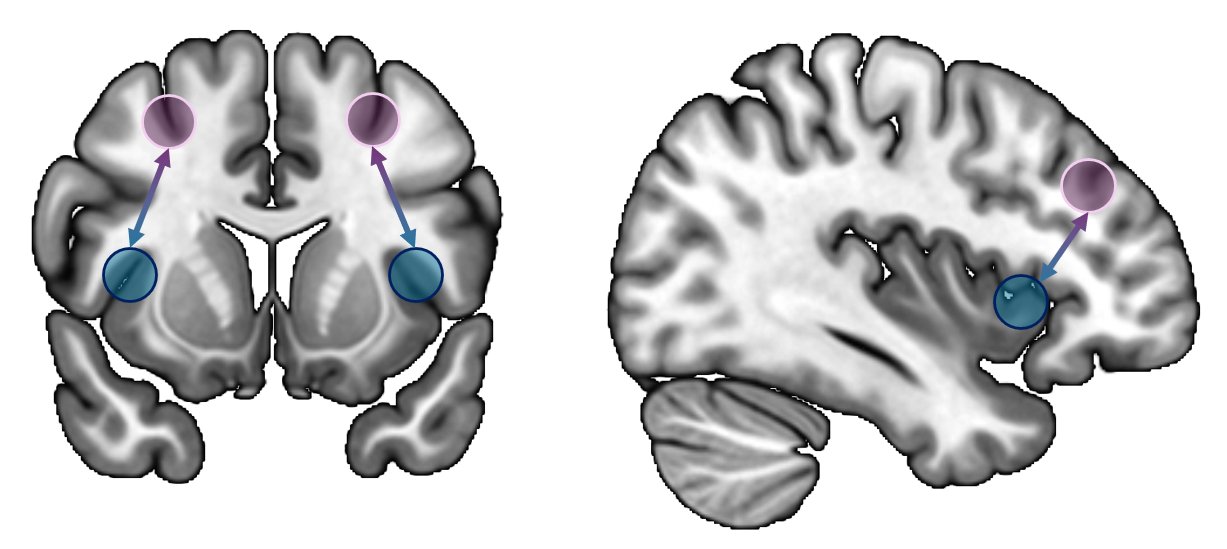
In the brain, the value of the chosen options was tracked by the anterior cingulate and medial prefrontal cortex, nucleus accumbens and, yes, the insula. And it was the insula whose value signal changed when people were tired. Meanwhile, the dorsolateral prefrontal cortex (the workhorse region for this kind of task) became more active with every round of 3-back, even though the task stayed exactly the same. And during the tired choices, this prefrontal region and the insula 'sync up' more intensely than during the fresh ones.
The authors' story: the prefrontal cortex keeps track of the mental work you've been doing, passes this on to the insula, and the insula uses it to make effort look more expensive. It's a great study: clean design, choices with real consequences, and all data and code openly shared. And it gives the insula exactly the role we sketched almost two decades ago. (They don't cite our paper, but I'll try not to take that personally.)
Where the story gets less tidy
So, case closed? Not quite. A few loose ends remain.
First, who is talking to whom? Two brain regions whose activity rises and falls together are like two people dancing: you can see they move in sync, but not who's leading. The analysis used here simply can't tell. The authors assume the prefrontal cortex leads. But the opposite is at least as plausible: the insula senses that you're running low and tells the prefrontal cortex to work harder, or to give up. In fairness, there is evidence that the prefrontal cortex can take the lead. When researchers temporarily disrupt it with magnetic stimulation, people's willingness to invest mental effort changes, and so does how quickly fatigue builds up (Soutschek & Tobler, 2020). Most likely, the traffic runs both ways.
But for me the biggest question that remains is: what is fatigue, what is telling the brain how much work has already been done? Fatigue builds up over time, so somewhere in the brain, something should be building up too. Steward and colleagues propose that the prefrontal activity constitutes an exertion signal, but the mental effort exerted per trial does not change (doing a 3-back trial for the first time requires exactly the same amount of effort as doing it for the 50th time). Also the observation that the people whose prefrontal activity rose the most actually felt the least tired does not fit with such an interpretation. It fits much better with another reading: the extra activity is extra effort, invested to keep performance up (which it did!). And the people who felt most fatigued were the ones who stopped investing. That is a motivational story, and exactly what our 2008 account would predict.
The authors do point to candidates for what builds up, such as the accumulation of the neurotransmitter glutamate in the prefrontal cortex, which a team in Paris found after a long day of hard mental work (Wiehler et al., 2022). This hypothesis is attractive also because it aligns with what is known about how physical fatigue impacts on task performance, but it is not uncontested (Möller, 2023).
The question what fatigue actually is, remains difficult to answer. We did not clearly specify this in our 2008 paper, and also this new paper by Steward and colleagues does not provide us with a definitive answer. But it is good to see this field of research moving forward!
Doing the math
Back in Groningen, our tired volunteers perked up the moment there was something worth working for. Their brains weren't empty. They were doing the math. Thanks to Steward and colleagues, we now know much more about where that math gets done. What we still don't know is what's being counted.
So next time you hit the late-afternoon wall, don't think of your brain as a car that's out of fuel. Think of it as an accountant who has just looked at the bill, and decided you've done enough for today!
References
Boksem, M. A. S., Meijman, T. F., & Lorist, M. M. (2005). Effects of mental fatigue on attention: An ERP study. Cognitive Brain Research, 25(1), 107–116. https://doi.org/10.1016/j.cogbrainres.2005.04.011
Boksem, M. A. S., Meijman, T. F., & Lorist, M. M. (2006). Mental fatigue, motivation and action monitoring. Biological Psychology, 72(2), 123–132. https://doi.org/10.1016/j.biopsycho.2005.08.007
Boksem, M. A. S., & Tops, M. (2008). Mental fatigue: Costs and benefits. Brain Research Reviews, 59(1), 125–139. https://doi.org/10.1016/j.brainresrev.2008.07.001
Möller, H. E. (2023). Considerations on gradual glutamate accumulation related to cognitive task performance. Journal of Cerebral Blood Flow & Metabolism, 43(3), 476–478. https://doi.org/10.1177/0271678X221139550
Soutschek, A., & Tobler, P. N. (2020). Causal role of lateral prefrontal cortex in mental effort and fatigue. Human Brain Mapping, 41(16), 4630–4640. https://doi.org/10.1002/hbm.25146
Steward, G., Looi, V., & Chib, V. S. (2025). The neurobiology of cognitive fatigue and its influence on effort-based choice. Journal of Neuroscience, 45(24), e1612242025. https://doi.org/10.1523/JNEUROSCI.1612-24.2025
Wiehler, A., Branzoli, F., Adanyeguh, I., Mochel, F., & Pessiglione, M. (2022). A neuro-metabolic account of why daylong cognitive work alters the control of economic decisions. Current Biology, 32(16), 3564–3575.e5. https://doi.org/10.1016/j.cub.2022.07.010